Hip Hop Speaks Out

Childish Gambino This is America

This is America
Don’t catch you slippin’ now
Look what I’m whippin’ now
This is America (woo)
Don’t catch you slippin’ now
Look what I’m whippin’ nowThis is America (skrrt, skrrt, woo)
Don’t catch you slippin’ now (ayy)
Look at how I’m livin’ now
Police be trippin’ now (woo)
Yeah, this is America (woo, ayy)
Guns in my area (word, my area)
I got the strap (ayy, ayy)
I gotta carry ’em
Yeah, yeah, I’ma go into this (ugh)
Yeah, yeah, this is guerilla, woo
Yeah, yeah, I’ma go get the bag
Yeah, yeah, or I’ma get the pad
Yeah, yeah, I’m so cold like yeah (yeah)
I’m so dope like yeah (woo)
We gon’ blow like yeah (straight up, uh)Ooh-ooh-ooh-ooh-ooh, tell somebody
You go tell somebody
Grandma told me
Get your money, black man (get your money)
Get your money, black man (get your, black man)
Black manThis is America (woo, ayy)
Don’t catch you slippin’ now (woo, woo, don’t catch you slippin’, now)
Don’t catch you slippin’ now (ayy, woah)
Look what I’m whippin’ now (Slime!)
This is America (yeah, yeah)
Don’t catch you slippin’ now (woah, ayy)
Don’t catch you slippin’ now (ayy, woo)
Look what I’m whippin’ now (ayy)Look how I’m geekin’ out (hey)
I’m so fitted (I’m so fitted, woo)
I’m on Gucci (I’m on Gucci)
I’m so pretty (yeah, yeah)
I’m gon’ get it (ayy, I’m gon’ get it)
Watch me move (blaow)
This a celly (ha)
That’s a tool (yeah)
On my Kodak (woo, Black)
Ooh, know that (yeah, know that, hold on)
Get it (get it, get it)
Ooh, work it (21)
Hunnid bands, hunnid bands, hunnid bands (hunnid bands)
Contraband, contraband, contraband (contraband)
I got the plug on Oaxaca (woah)
They gonna find you like blocka (blaow)Ooh-ooh-ooh-ooh-ooh, tell somebody
(America, I just checked my following list and)
You go tell somebody
(You mothafuckas owe me)
Grandma told me
Get your money, black man (black man)
Black man (one, two, three, get down)Ooh-ooh-ooh-ooh-ooh, tell somebody
You go tell somebody
Grandma told me, “Get your money, ” black man
Get your money, black man (black man)
Black manYou just a black man in this world
You just a barcode, ayy
You just a black man in this world
Drivin’ expensive foreigns, ayy
You just a big dawg, yeah
I kenneled him in the backyard
No proper life to a dog
For a big dog

In this song, Childish Gambino covers many social problems. Such problems included are about guns and violence in America and long lasting racism and discrimination against African Americans, and brings attention to the Black Lives Matter Movement. With such a famous platform, I like how Childish Gambino took advantage of it to spread awareness and bring intention to such harsh issues happening in our country.

J. Cole Be Free

And now I’m in denial
And it don’t take no x-ray to see right through my smile
I know, I’ll be on the go
It ain’t no drink out there that could kill my soul
Oh no
All we want do is take these chains off
All we want do is break the chains of pain
All we want do is be free
All we want do is take these chains off
All we want do is break the chains of pain
All we want do is be free
All we wanna do is be freeCan you tell me why every time I step outside
Ooh, I’m letting you know
That it ain’t no gun they can make that could kill my soul
Oh, noAll we want do is take these chains off
All we want do is take the chains of pain
All we want do is be free
All we want do is take these chains off
All we want do is break the chains of pain
All we want do is be free
All we wanna do is be freeAhh we all alone fighting on our own
Please give me a chance
I don’t wanna dance
Something’s got me down
I was there my ground
Don’t just stand around
Don’t just stand aroundAll we want do is take the chains off

With the same focus as Childish Gambino, J. Cole in his song Be Free he talks about after the police killing of teenager Mike Brown in Ferguson, artistic outpour erupted within the hip hop community- J. Cole’s tribute was the most influential.
How To Spot Fake News

If you have ever scrolled through the internet and came across a news article that seemed just too outrageous to be true, you were most likely reading a “Fake News” article. Fake news is “news”  made up by journalists in order to make people be influenced in a certain way. It often causes people’s opinions get swayed without any real evidence, and no one knows what to believe. This is a common issue during things like political campaigns and elections because people are able to create a false news article about a candidate from their unpreferred political party in order to make them look bad. So how can you be able to tell when news is factual, or when it is simply “Fake News”?

The first giveaway for spotting fake news can be found within the title. If it seems as if it is using an absurd amount of exclamation marks, question marks, or “OMG”s, most likely, it is fake news. Also, if the title seems way too crazy to even be true, then odds are it probably isn’t. This is called “clickbait”, and it is when journalists stretch the truth in their article titles in order to get more views. It is also extremely important to take note of the source that the article is coming from. For example, sites like “The Onion” are known for often posting fake news articles, while sites like “The Washington Post” are usually pretty reliable. You should always keep eye out for articles that don’t have an author listed, because that is a red flag that the article is fake, and they don’t want to take credit for it. When dealing with online news, it is important to be critical of every source and look for these warning signs before trusting them.

(Written by Meghan Smith)

Fake news is also seen through gossip about celebrities. This can sometimes cause havoc as super fans of certain celebrities might believe such rumors flying around.

Checkout the video below to know how to spot fake new in five easy ways…

The case of Lord McAlpine vs the BBC

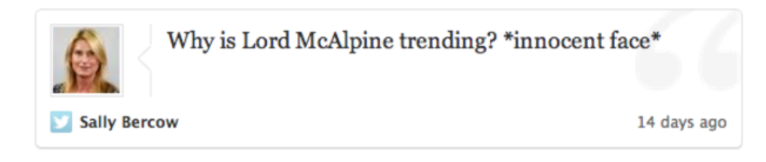
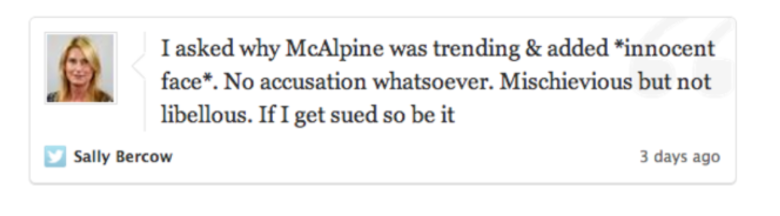
The case of Lord McAlpine vs the BBC, ITV and prominent Twitter Users was an interesting case because A reporter from a BBC news watch reported on some tweets that claimed Lord McAlpine was a pedophile. This of course could damage his reputation and give people the wrong perception of him, and all of this came about through the medium of social media. The claim stated that anyone who had above 500 followers and tweeted about the incident would receive a hefty fine while other who have less would donate to the BBC charity.

Monbiot and Davies who were two other involved in the case who sincerely apologized to lord McAlpine and got lesser punishments then Bercow who had 56000 followers on twitter at the time. In the judgement in the court between Bercow and McAlpine it was decided by both parties, Bercow pay for the damages she had done, since she was a credible reporter and has the ability to reach a large variety of different people, and change the public’s perception about the reported on person. Overall, I think this case directly relates to some of the points we have spoken about this semester.


independent.co.uk (Getty Images)

Such as privacy and credibility, it invades McAlpine’s privacy by someone exposing information about him that is not even true in this case. While also someone who is a credible source gives people all the reason to believe what is said. I am a big believer that defamation is a serious problem that we face in our society today, some have the ability to impact other lives through social media just by mentioning their name, so when you have a person that people listen to report something that is not true, in this case on a matter such as pedophiles, there can really be no good to come from it. It can be one thing for people to make such claims about a person with no evidence through twitter, but to have it on a news channel such as BBC and ITV affects the credibility of the news sources.

Written by Leon Maric

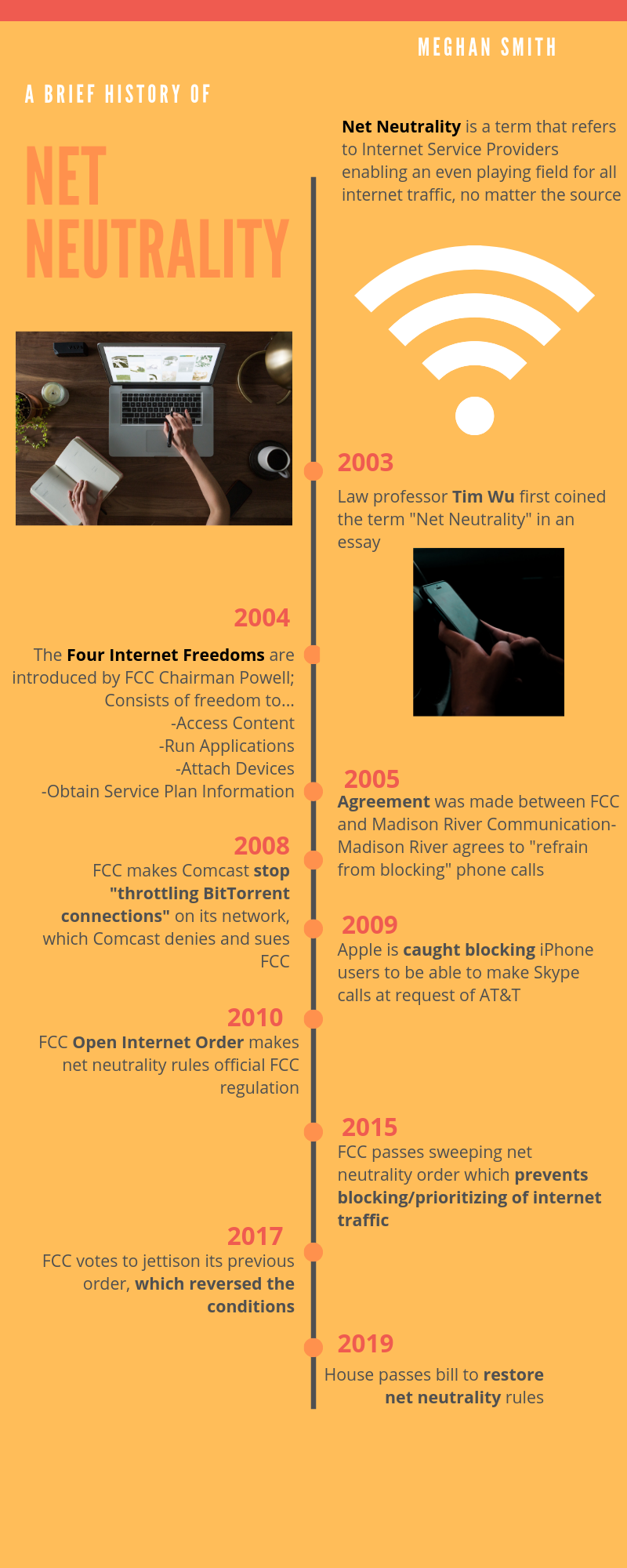
What Is Net Neutrality?

Meghan Smith

This week in our Com 201 class, we were introduced to the topic of Net Neutrality. In my brief video below, I explain exactly what “Net Neutrality” means, but here’s some background knowledge you should keep in mind first…

ISPs stand for “Internet Service Providers” and are big name companies like Verizon, Comcast, Megapath, etc. Without Net Neutrality, these companies would hold control of the internet traffic.

There are several downfalls for the average internet user. First of all, our content could be censored depending on which sites big-name ISPs want you to be using. They can also slow down our service on smaller sites or competitors. For example, in 2014, Comcast was able to slow down Netflix’s services until they made a deal that Netflix would pay Comcast.

Many internet user have taken it upon themselves to stand up for their internet rights. Over 4 million individuals have commented on the FCC website in order to fight for Net Neutrality. People have also taken the issue to social media, posting content in order to spread awareness of the issue.

In this Tweet, Sonos, a home sound system company, urges the importance of net neutrality for artists in order to be able to work freely, with no restrictions for ISPs. It acted as a response for the #Savethenet Act that the house voted on recently.

All of the support from citizens on the #Savethenet Act proved to be successful. On April 10th, 2019, The House of Representatives voted to pass a bill that would restore net neutrality protections that were recently repealed. As for now, internet users can take a breath of relief; net neutrality is back and ready to to return the internet into an even playing field.


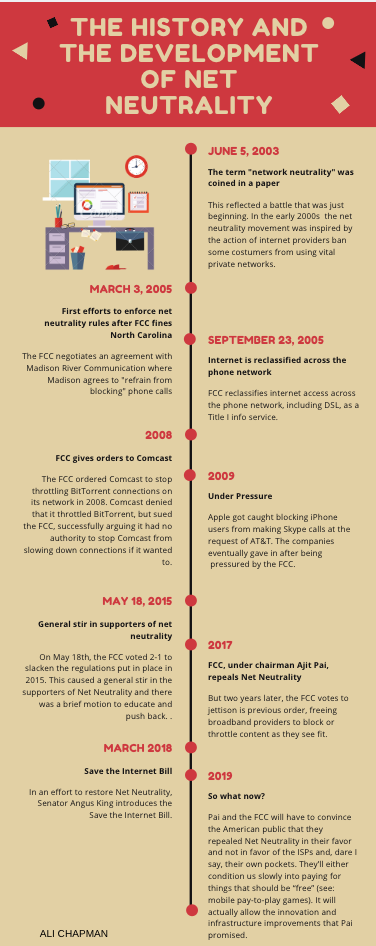
Net Neutrality

Ali Chapman

Net neutrality is made of rules, backed by sanctions, that ensure all Internet content be treated equally by the companies we pay to get online. It makes Internet service providers treat all web traffic the same, no matter the source. The policy’s defenders say the regulations are at the heart of the idea that the Internet should be an open space where information travels freely without interference from service providers. It is the basic principle that prohibits internet service providers like AT&T, Comcast and Verizon from speeding up, slowing down or blocking any content, applications or websites you want to use. Net Neutrality is the way that the internet has always worked.

Under net neutrality, broadband companies are like passive conduits of data rather than content managers. When a customer pays Comcast or Verizon for Internet service, they’ve can expect to connect with equal access to any website, whether big or small. But, the FCC voted on Dec. 14 to kill net neutrality and unravel an Obama-era move that placed broadband regulation on a stronger legal footing.

Defenders of net neutrality say dismantling the current rules is anathema to a free and open Internet, and hurts online companies and consumers alike. Net neutrality advocate Ryan Singel, a media and strategy fellow at Stanford Law’s Center for Internet and Society, said the FCC’s dismantling of net neutrality means abandoning its traditional role as the protector of Americans’ right to choose which sites and apps they access.

Without the Net Neutrality rules, companies like AT&T, Comcast and Verizon can call all the shots and decide which websites, content and applications succeed. At the core of net neutrality is a hidden free speech principle that allows speakers and innovators to reach the people that they wouldn’t have if they cut the cable. Without net neutrality, control of the internet shifts from edge providers and users into the hands of broadband ISPs, who could operate as content-gatekeepers, demanding pay-to-pay tolls from edge providers, and thereby determining what info or services users can access


They’re Always Watching

Algorithms are comprised of a formula. The idea of an algorithm in terms of social media, is the way your feed on twitter, instagram, etc. is formatted based on what you search on Google. They are set of steps to accomplish a task. Challenges posed by algorithms are that we get a filter bubble. With filter bubbles, can miss out on what else is happening by only seeing things that are relative towards our interests. Algorithms are created by humans. Technology is like the brain, it has connections, feeds off of what people do, and reflects the public opinion of society. The problem lies with the people who built it and constantly feed into that site everyday.     

When scrolling through your feed on any social media network, you are likely to come across ads for products, places, events, that you have previously google searched or even simply texted about. Facebook keeps up with the personal engagements you have with posts by friends and brand pages. The Facebook News Feed algorithm also predicts what you want to see based on those past interactions with friends or brands. Many believe this is an invasion of privacy as they feel they are being watched since these sponsored ads were searched on other sites and transported over to your Facebook feed. For instance, if I am on a clothing website and add a certain piece of clothing to my cart and leave the site without purchasing anything, I will find an ad of that exact article of clothing in an ad on Facebook or Instagram.

Even when I am on the site Quizlet studying for an upcoming quiz or exam, ads pop up for clothes that I have added to my cart yet not purchased on a different site. Though social media is free, they make money by advertising paid sponsored ads based on our searches on other sites. The algorithm of your social media feeds are not only based on who you interact with the most, they also include sponsored ads based on what you search, as filter bubbles make your feed relative to your interests. Social networks use algorithms instead of putting posts in chronological order as it makes your feed “feel more fresh”.

Watch the Youtube video below to see how Instagram’s algorithm determines what your feed looks like.


Webcam Hacking

This week during our Ethics in Media class, we were assigned to watch an episode of the TV show, Black Mirror, called “ Shut Up and Dance”. The episode was about a teenage boy, as well as several other victims, who had their webcams/electronic devices hacked, and the attackers used blackmail in order to make them complete several immoral actions for the hackers’ own amusement. While the episode was entertaining, it brought us to a much broader, unsettling question- Could this type of situation occur in real life? To our dismay, we learned that this hacking strategy is a very real, very scary occurrence. In this week’s blog post, you can learn all about the Ins and Outs of webcam hacking, as well as how to best avoid the situation.

Many hackers use things like downloads to access other peoples computers, in the case of the black mirror episode “Shut Up and dance” the main character Kenny got a  virus on his computer from a free online movie site that his sister was using. He download a free clean my pc software where a hacker got a hold of his webcam cam blackmailed him to the point where it ruined. What can this episode teach you? For starters nothing is free and be careful of the things you download online because hackers can access your technology.

In 2014, Emma Watson became a target for a hacker after tweeting her thoughts about a recent hacking scandal. She said, “Even worse than seeing women’s privacy violated on social media is reading the accompanying comments that show such a lack of empathy.” In March 2017, Watson was hacked once again. Although she wasn’t nude in the photos, the pictures are of her trying on outfits during a fitting.


Online speculation that US actor Jack Black had died was the work of a hacker who posted messages on his rock band’s official Twitter account.This was later confirmed by Tenacious D themselves, who called the hacking a “sick ‘prank'”.

Let’s Talk About the Intellectual Properties

Copyright

The tangible and exclusive legal right that applies ownership to the creator and protects the ‘expressions’ of some ideas, but not the idea itself. It lasts for 70 + years after author’s death. The author of the work has the ‘moral right’ to be identified as the author of the work and object to the distortion of the work. Economic rights associated with copyright vest in the owner of the copyright. The owner could be different from the author. For instance, in the case of a book, the owner of the copyright could be the publisher, and in the case of the movie, it could be the producer. In some instances, copyright may be jointly owned as well.

Patents

Patents are known as the set of exclusive rights granted by a sovereign state to an inventor. A patent lasts 20 years for a utility patent, and 14 years for a design patent, beginning from the day that the patent application was filed. Patents protect inventions,which could either be products or processes. The requirements for an invention to be patented is that it must be useful, non-obvious, and new.

Trademarks

Trademarks are defined as a recognizable symbol, sign, expression, design , etc. which is used to identify and differentiate one product or service from another. Some common examples of trademarks that you probably encounter on the daily are the McDonald’s Golden “M” symbol, or the famous Nike Swoosh. An interesting fact about a trademark is that it never expires; it lasts forever! Also, there is no need to apply for a trademark because the minute the owner puts it in a tangible format, it is already protected by copyright. Even the Kardashian-Jenner sisters have filed documents to trademark the names of their children on a number of products including clothing lines, toys, and skincare products. Kylie Jenner and Travis Scott filed a trademark for “Stormiworld”.

Trade Secrets

Trade secrets are the information that act as a “secret device” for manufacturing a company’s products. These secrets could act as a formula, program, method, process, pattern, etc. An example could be a secret formula to Coca Cola. Unlike the other forms of protection such as copyright, trademark or patent this does not have to be in a tangible medium this can simply be an idea that one company develops and discloses the information from the public, that is where the term secret comes into play.  

Should Internet Users Have The “Right To Be Forgotten”?

This week in Communications, we examined the case of Justine Sacco concerning her controversial Tweets. These Tweets were seen as unnecessary and offensive to certain groups of people, yet she claims it was all a joke and not meant to be taken seriously. However; this joke ended up being the cause of the complete downfall of both her professional and personal life. Cases like Sacco’s bring up the very argued question- Should we, as internet users, have the right to be forgotten? Should our mistakes and embarrassments be able to be permanently deleted from the internet? We interviewed each of our four group members concerning the subject, and here are their responses:

Do you feel that Justine Sacco deserved to lose her job for her Tweets?

Alvin– I think at 30 years of age and a person in such a high position as Justine Sacco, I think you should be very careful about what you says and do especially on the internet. I don’t know what was her intention, and of course, intention is not the same as effect. Whatever Sacco meant, her tweet was gross and offensive and I think she deserved to lose her job because her job had a lot to do with public relationship.

Ali– I feel that tweets similar to Sacco’s are completely inappropriate and are not professional. Everyone should be aware that once they post something on the internet, it is there forever. Though losing her job seems severe, I believe that it was a great awakening for her and others. As simple as it sounds, she should have known better and considered the consequences of her tweets.

Leon– I feel that in general someone should not lose their job for something they may have said prior in their life, but in the case of Justine, her comments affect the way people may look at the company, therefore having her on their team may send the wrong image of what they want their brand to be about. Therefore, I think it is up to the company as what they want to do with employees in cases like this and have no problem which way they choose to go with their decision. But in the case of Justine I feel like she got what she deserved.

Meghan- I feel that although this punishment seems a bit extreme, her employer did not really have the option of keeping her, as the entire internet world had seen her Tweets by this time and caused an uproar. If they didn’t fire her, they knew that they would have faced serious backlash from the general public and ruined their reputation as a company.

Do you believe that what you post on the internet should be permanent?

Alvin- I am kind of in the middle with this, I think that kids under at least 15 years of age should be allowed to permanently delete their post from the internet, but at the same time I think that will make kids even more reckless with the internet, I think we as humans are term to do better with consequence, therefore I’m going to say No!!

Ali- Personally, I believe it depends on the content. If it an embarrassing photo or video, yes. But if it is a post where someone is degrading/insulting others and they are an adult who should know better, why would they worry about deleting it if they made the decision post it?

Leon- I think the idea of permanently deleting something from the internet goes against our idea of freedom of speech. So deleting things from the internet since we live in such a digital age is kind of like deleting history. What if that information posted is important to future generations and can provide knowledge? Then there are some cases such as bullying where I think that posts should be taken down but because it violates certain guidelines set out by the creators of these sites, the case of bullying is one of the only reasons why I could see something being deleted from the internet.

Meghan- I believe that if the content posted was by somebody else with the intention of making you look bad or embarrassing, then yes, it should be able to be deleted. However; if you personally post something, whether or not it may offend someone or unintentionally make yourself look bad, you should be held accountable for that content and face whatever consequences come with it.

What do you think the positives are of the right to be forgotten on the internet?

Alvin The right to be forgotten can give people who had made mistakes on the internet a change at life. Especially in a country like the United States where people have the right to freedom of speech, people could say many things that they might not have the same view in the future, the right to be forgotten can forgive and forget the passed and leave it in the past.  

Ali- Though there are certain cases that hard to justify, If someone evolves and changes perspectives, I believe that we are able to forgive and forget their past mistakes as they now know and do better. This could help society as a whole in making others aware that it is possible to change from a negative to a positive person if we enable ourselves to forget about their past and move forward.

Leon- People can forget their past mistakes without them having to be constantly reminded of them. Like mentioned in the TED talk earlier this week I think that forgetting allows for forgiveness, therefore by forgetting certain things it will allow grudges to pass and new healthy relationships be built.

Meghan- An important advantage of being able to be forgotten on the internet is that if someone was cyberbullied, they would not have to be constantly reminded of those hurtful comments or relive them every time they logged on to the internet.

What do you think the negatives are of the right to be forgotten on the internet?

Alvin- The lack of transparency surrounding important information about a person and potencial retrain on media, journalist and other freedom of speech.  

Ali- We could potentially fall into a trap as we are unaware of the truth behind someone. If you enforce this right to be forgotten, your denying the internet’s ability to have access to information. It’s a massive shift of a burden and is a cost. It clouds the enforcement of human rights.

Leon- The negatives about the idea of “right to be forgotten” is that it may provide a fake sense of news and information to people. If you are hiring someone for a job and they are able to delete a history that may be controversial, then in essence you are not hiring the person you think you are. Also, deleting certain things may be detrimental to society as a whole because then people may feel free to say or express whatever they want with the knowledge that it can be deleted whenever they choose, making their thought process at certain moments careless or naive.

Meghan- The biggest flaw in the right to be forgotten is that people would no longer have to be held accountable for their words, which may cause the various comment sections of social media to become nastier and crueler than they already seem to be. Especially for important public figures who hold positions of power in the world, it is important that the public can have access to their past before supporting them.

While we all had varied responses and ideas about the concept of “The Right to be Forgotten”, it is important to see that there are always two (or more!) sides to every story. Like most issues we have studied so far in our Ethics of Media course, there are no clear black or white decisions that can be determined; only a ton of controversial, imperfect gray area.